Showing posts with label Haunted House. Show all posts

Monday, July 11, 2011

'Gothic' is an excursion into nightmares
that's not for everyone

Gothic (1986)
Starring: Gabriel Byrne, Natasha Richardson, Julian Sands, Myriam Cyr, and Timothy Spall
Director: Ken Russell
Rating: Seven of Ten Stars

Eccentric poet Lord Byron (Byrne) invites a young prodigy Percy Shelly and his fiance Mary Wollstonecraft (Sands and Richardson), along with her halfsister Claire Claremont (Cyr) to spend a weekend with him and his personal doctor, Polidori (Spall), at his isolated estate. After an evening of reading ghost stories, drinking wine enhanced with Laudanum (a hallucinogenic), and an impromptu seance, these members of the cream of the Age of Enlightenment's intellectual crop find themselves trapped in an ever worsening spiral of confusion and terror. Is it just the drugs, or did the seance call forth an evil spirit which is now tormenting them?


"Gothic" is a stylish, extremely creepy movie. There are very few films I've seen that manage to transfer the dread and fear felt by the characters as the film unfolds to me, but this is one of them. Although it starts out feeling like "Who's Afraid of Virginia Wolfe?" set in a rambling castle and performed by effeminate people in puffy shirts and bad hairdos, this movie soon turns into one of the most bizarre and terrifying films I've ever seen. Much of it unfolds seemingly at random, with the threads occasionally coming briefly together but invariably separating into a chaotic mess again.

While I would usually find this to be a flaw, it is something that works with great effect here.

The film has an odd tone to it from the very first arrival of Shelly and the girls at Byron's estate, and that oddness kicks into full fledged horror movie mode when the characters start reading ghost stories to each other. At that point, the passage of time, and the very nature of reality, the house, and those in it start to change. As a thunderous rainstorm batters the manor house, Byron, Shelly, Polidori, Mary, and Claire all seem to be drawn into ghost stories, and singly or together, they all experience one of more hallmarks of such tales, ranging from apparent possessions to hallucinations of all kinds.

In fact, while "Gothic" is not a movie about a haunted house, it should serve as required viewing for anyone who is thinking about making a haunted house movie. The way the house becomes a character unto itself as the film unfolds, the various torments the character's experience, the possessions... they're all haunted-house standards, and they're all handled with far greater skill than in the vast majority of movies that deal specifically with hauntings.


A great deal of the film's success can be credited to Gabriel Byrne. He gives a wonderfully varied performance as the twisted poet Byron, but he is also portraying the one character who remains stable throughout the film. Byron stars out as an unbalanced character--swinging from capricious, to sensitive, to menacingly insane, sometimes all within the space of a few minutes--but as the other characters come increasingly unglued, Byron emerges as the closest thing there is to a stable hold on reality. Whether in the dying light of a spring afternoon, or in the deepest part of a nightmare-made-real, Byrne's Byron is unchanged... and this contributes to the viewer's sense of unease; the abnormal has become the closet thing to normal, anywhere. Byrne, however, is merely a point man for an excellent cast. All the principles are great (Cyr is genuinely creepy after she's possessed (?)), and given the length of some of the shots and the difficulty of the dialogue delivered during them, I don't think this was an easy movie to star in.

Although the amazing use of Byron can also be credited to the script, there are some issues with the script as well--mostly relating to where the line between what's a dream and what's reality in the film is--and this cost it a Tomato in my rating. However, I may be overcritical on this point, because once "Gothic" gets going, the terror and disorientation builds and builds to such a degree that reality and drug-soaked nightmare and which is which really doesn't matter. And the way you can see the works of Mary Wollstonecraft-Shelly and Percy Shelly (and almost certainly also that of Dr. Polidori, although I've not read his book "The Vampyre", so I can't say) echoed throughout in dialogue and situations

This film is one scary ride, featuring fine performances from all its actors, and led by a director that deploys every tool in his filmmaking arsenal with great skill and artistry. It's a film worth seeing if you enjoy well-made horror flicks and experimental films, but it does require some patience and tolerance of artsy-fartsy flourishes.


(Oh... I suppose I should touch on what many reviewers seem to think is a selling point. The film supposedly chronicles the one night that gave rise to Mary Shelly's "Frankenstein", Shelly's best poems, and Polidori's "The Vampyre". While this is an interesting aspect of the film--and it's one that raises even more questions about where the line between reality and nightmare exists in the movie, and if perhaps Byron and his guests did, in fact, rouse some evil spirit that night--it's not one that felt was so all-fire important to the movie. It helps to know who the characters are, but one doesn't need a BA in English to "get it.")

Thursday, December 16, 2010

'Screaming Dead': When Misty Mundae started keeping her clothes on

Screaming Dead (2003)
Starring: Rob Monkiewicz, Rachael Robbins, Joseph Farrell, Misty Mundae, and Heidi Kristoffer
Director: Brett Piper
Rating: Four of Ten Stars

A sadistic photographer (Farrell) isolates a trio of young models in a house and proceeds to subject them to abuse and psychological torture. His evil manages to awaken the ghost of the madman who built the house, who then picks up where he left off and sets about torturing the women to death slowly.


Although that summary may make "Screaming Dead" sound like yet another piece of offal floating in the stream of torture porn movies--and with Misty Mundae starring, one might think the film to be literal torture porn--but it's more of a " sexy girls in a haunted house" movie in the mode of the cheap and sleazy European horror films from the 1960s and 1970s. Unfortunately, like the worst of those, it spends too long on the wind-up, not getting interesting until the movie is half over, and not getting to the reason most of us would be watching this film: the haunted house stuff. (The rest are going to be even more disappointed; the nudity quotient in the film is very, very low for a Misty Mundae movie and the lesbian nookie is even lower. One of the films better moments even makes playful fun of the lesbian softcore scenes that are a staple of the horror-themed sex comedies that Mundae and the producers behind "Screaming Dead" initially made their reputation on.)

The greatest flaw of the film is the unbelievable nature of its lead villain, the abusive photographer played by Joseph Farrell. A misogynistic, sexual sadist like this character might have been believable in a film made and/or set 40-50 years ago, but no matter how supposedly famous and well-respected he is as an artist, he would have been sued into the poor house or sent to prison long ago. Unless he paid his regular employees many hundreds of thousands of dollars in hush money--and with the repeated insistence that his models were working for free that seems unlikely--and his models even more, someone would have put a stop to his real-life "torture porn" long before the film started. No one could get away with abusing a model in this day and age of scandal-hungry, ever-present tabloid media the way he does in the film's opening scene, where a busty young lady is strapped to a table as a spike descends to impale her. Roman Polanski's celebrity and time lets him obscure the fact that he's a pedophile rapist, but if he had behaved that way in 2003, especially if he had beaten the girl instead of "just" drugging her, he'd be as reviled as Michael Jackson. (Of course, if he disposes of the models in a permanent way when he's done, the problem is lessened, but there is no indication that he is an out-and-out murderer, just a sadistic sociopath.)

The film's hero, the real estate company employee played by Rob Monkiewicz, also comes with his own unbelievable qualities to make the plot work. A rough-around-the-edges tough-guy with a chivalrous attitude, he is present at the photo-shoot by order of his employer to make sure the location the photographer has rented isn't damaged, and that the photographer isn't doing things that will expose the real estate company to liability. Within fairly short order, he witnesses several acts on the part of the photographer that his failure to report the photographer to the authorities exposes no only himself but his employers to lawsuits of mind-boggling size, especially when he points out to anyone who will listen how dangerous and illegal locking people in their rooms or chaining them to beds is to anyone within ear-shot. It is not believable on any level that a character drawn as a man of action like this one wouldn't do something to stop the abuses he sees long before he does, even if it means calling the police. While he is set up as a shady character, I also have the impression that he wouldn't be above using either the law or some of his unsavory contacts to shut down someone he finds as disgusting as the photographer. But for the character to try this, the film would either have needed a bigger budget--as it would require more cast and possibly additional locations--or a script that had been better thought out and which got to the point faster.


These problems with the hero and main villain of the film arise from a combination of a desire on co-screenwriter and director Brett Piper is giving us characters with a little depth to them, and the fact that he spends too much time dithering why trying to draw that depth. It takes entirely too long for the real ghosts to arrive on the scene and for the characters to be trapped inside the house. If Piper had move more quickly with introducing his torture-obsessed ghost, none of the problems with the reality of the film would have been an issue, because reality would have been suspended much sooner. And the fact that the film is really clever in the way in mixes the supernatural and hi-tech once, not to mention that it gets pretty scary in its final 15-20 minutes, shows that Piper is capable of delivering the goods... when he finally puts his mind to it. I really wish the first 3/4ths, because the horror that eventually comes deserved a better lead-in.

As for the cast, cinematography, and special effects, everything here is about what you might expect from a Shock-O-Rama/Seduction Cinema film. No one is going to win any awards for their work on the film, but no one needs to hang their shame over their efforts, either.

Farrell and Monkiewicz, as the evil photographer and heroic rental agency rep respectively. Both are as excellent in their roles as can be expected given the dialogue they are called on to deliver and the flabbiness and badly structured script they are performing. Farrell in particular shines in the one truly horrific scene in the movie where Misty Mudae's character is slashed to ribbons by an invisible force as he takes pictures. That same scene is where Mundae has one of several opportunities to show that she actually has a great deal of talent for acting.

But, in the end, "Screaming Dead" neither has enough screaming, nor enough dead, to make it worth checking out. It's of interest to big fans of Misty Mundae as it marks the beginning of her ascension from softcore porn and ultra-low budget movies to more serious-minded horror flicks, as well as the dawn of Pop Cinema as a multi-faceted, modern-day exploitation film production company, but most will be underwhelmed this film. As well done and horrific as the scene of Mundae's character being violated and mutilated is, what leads up to is simply too weak to be worth bothering with.


Saturday, October 23, 2010

'Deadline' needed more intensity, faster pace

Deadline (aka "Ghost House")(2009)
Starring: Brittany Murphy, Tammy Blanchard, Thora Birch, and Marc Blucas
Director: Sean McConville
Rating: Four of Ten Stars

A writer recovering from a mental breakdown (Murphy) retreats to an isolated house owned by her agent in an attempt to finish the script for a horror movie. She soon discovers the house holds a dark secret... and that she may not be alone. But is she being stalked by her murderous ex-boyfriend, a vengeful ghost, or phantasms conjured by her broken mind?


"Deadline" is a cross between the "writer goes crazy" sub-genre and the venerable gothic thriller where the main character is a psychologically unstable woman that is either out of her mind, or someone is trying to drive her there with a fake haunting. As far as that goes, it does a fine job in blending these two old-fashioned horror stories and updating them to current times with cell phones, lap tops, and digital camcorders. It also manages to keep the truth of what's going on with the writer and the house an open question up to the very end. And when the truth is revealed, it's not a huge shock to anyone familiar with either of the genres being fused in this film, but it is nonetheless somewhat pleasant that it ends up being slightly unusual.

But what isn't done well here is the pacing. Even at 85 minutes, the film feels slow and bloated. I understand that writer/director McConville wanted to establish the creepy nature of the house and to convey the sense of isolation and growing dread felt by Murphy's character as she roams its cavernous and shadow-filled rooms, but he didn't have to do it over and over and over. And the languid pace doesn't seem to pick up much even after the haunting begins in earnest; moments of horror are bursts of activity surrounded by more slow, nearly tension free scenes. The second and third acts of movies like this one need to be like a steel wire stretched nearly to the point of breaking, but here that wire remains mostly slack. If a total of five minutes or so had been cut from various places in this film, I think it would have made the difference between boring and horrifying.

As for the acting, the film is basically carried completely by Brittany Murphy. While she does an okay job--striking a nice balance between someone fighting for their life and someone who is having a complete mental breakdown--her overall performance seems to lack the energy and intensity that is required from an actor when they are by themselves on screen for the majority of a film. She did a far better job in the quirky slasher film "Cherry Falls" than she does here, perhaps because she had other actors to play off... or perhaps because of superior direction. It's hard to say, and we'll never know, because Murphy won't be doing any more slasher films or haunted house movies. She passed away in 2009.

If you're a big lover of gothic horror flicks, or perhaps a charter member of the Brittany Murphy fan club, this might be a movie worth seeking out. Everyone else can probably wait for it to show up on television where it may be edited and given the faster pace it needed.


Saturday, July 31, 2010

Two movies from one source: 'Lisa and the Devil' and 'House of Exorcism'

One of the DVDs included in the "Mario Bava Collection, Vol. 2" contains two different versions of the same movie. (It can also be had as a stand-alone from Amazon.com).

The first version is "Lisa and the Devil", which was a film that director Bava was given a completely free hand on after the commerical success of "Baron Blood." According to a number of sources, it was the film the he always wanted to make, the perfect expression of his vision through the craft he had spent decades honing.

And it was a tremendous flop.

"Lisa and the Devil" was such a such dud that it was only ever released theatrically in Spain, the country in which it was filmed--and then only in a single theater. No distributor was interested in picking it up, despite everyone who saw it at the 1973 Cannes Film Festival thinking it was an artistic masterpiece.

Two years after the failure of "Lisa and the Devil," producer Alfredo Leone set about to salvage his investment by re-editing it and adding scenes that gave the film an all-new exorcism plot in the hopes of riding the success of the "The Exorcist" (which was the first official blockbuster, ever). The revised film was released under the title "The House of Exorcism."

And it became an international box office hit.

"The House of Exorcism" has been described by some critics as a butchered version of as masterpiece. However, these same critics have a tendency to discuss Mario Bava with lots of hyperbole and using the word "genius" almost as frequently as "the" when writing about him. I am hesitant to trust any critic who describes Bava as a genius, so I am hesitant to take their word for the craptacular nature of Leone's re-cut. The more films from Bava I watch, the more I admire his command of cinematography and the visual language of film, but the overall packages that make up his movies are lacking. Most Bava films I've seen have tended toward the slap-dash and incoherent story-wise, as if he was putting together the films primarily to show off imagery. And, frankly, his movies too often call attention to the fact that he's doing something cool with the camera... he's too often doing things to just show off technique instead of doing things that serve the story for me to consider him a genius.

Here are review both "Lisa and the Devil" and "The House of Exorcism". The rating assigned at the top of this post is an average of the rating of the two films with some consideration for highly interesting commentary tracks.

As always, I encourage you to leave your thoughts in the Comments section. I'm interested in what others think about Bava's films in general, or these two films specifically.


Lisa and the Devil (1972)
Starring: Elke Sommer, Telly Savalas, Sylvia Koscina, Alessio Orano, and Alida Valli
Director: Mario Bava
Rating: Eight of Ten Stars

When Lisa (Sommer) is separated from her tour group and lost in the old section of Toledo, she is invited to spend the night on the large, walled estate of a reclusive noble woman (Valli). But who is the mustachioed stranger who is oddly familiar to Lisa, but who keeps calling her by the wrong name? Is it more than coincidence that Lisa crossed paths the household's only servant, Leandro (Savalas), just when she lost her way? And why do people start dying in the house? And why don't they stay dead?

So many questions will come to mind while you're watching "Lisa and the Devil." The answers to some of them seem to come into focus as the film progresses--Lisa has clearly been drawn into some bizarre haunting or the supernatural climax of some greater evil--but whatever starts to make sense is thrown into question by a "shock ending", which, like most shock endings doesn't really work because it's not quite supported by everything that led up to it. (It's a little better than most of them, but I think the film could have done without it, even if I can see how it harkens back to the beginning of the film and the image of the devil carrying off the sinful dead.)


This is a gorgeous-looking film that's well-acted and, although a bit slowly paced, is one that will engage your imagination and curiosity as it unfolds. It's also a movie that's surprisingly classical and literate in nature--it reminds me of the Edgar Ulmer's Karloff/Lugosi film "The Black Cat" from the 1930s, and it's full of references to classical art--and full of visual hints and clues that are never spelled out through any form of exposition. Watch the introduction of the Lehars and their driver... you know EXACTLY what's going on in that relationship even though nothing is said. It's a scene that's perfectly staged and acted. The same is true of the scene where Max (Alessio Orano) prepares to rape the unconscious Lisa. I think that's probably one of the creepiest bits of film I've ever seen.)

The film's imagery and pacing gives it a dreamlike quality that is highly effective here. From the moment Lisa "crosses the threshhold", every event, every image we see seems possessed with a deeper, hidden meaning and that a secret story is unfolding below and behind the surface. The broken watches, the odd clocks, the white rose, the blind mistress of the house, the servant who seems to be the one truly in control, Lisa herself... all of these things seem to be images that stand for something other than what is obvious. It's a very cool sensation, and it's one that Bava successfully maintains for most of the film. He doesn't even ruin the mood anywhere with the expected garish color gels or painfully overdone camera flourishes... part of this might be because he didn't serve as his own cinematographer on most of the film but it might also be that those critics who have described this film as Bava's masterpiece are not being hyperbolic. I'm still not convinced he was the genius some like to make him out to be, but I do think there is greatness present in this film. I also think that it was ahead of its time. If this film had been made and released twenty years later. in the 1990s when the direct-to-video market was flourishing, I think it would have been a huge hit. It is a movie that had no place in the 1970s film market, despite its excellence. (The "shock ending" after the film's main action has concluded is also a sign that the world was not ready for this movie. I can't say for sure that this was the first movie that was structured liked this, but it's definitely one of the earliest.)

By the way, the film also contains some of the sexiest non-nudity you're ever going to see in a slasher-film style death scene. Sylvia Koscina, who is remarkable for her habit of getting nude in movies, actually stays covered up here, but watch for scene where she gets bludgeoned to death by the red-robed killer. I'm sure you'll agree that she's ten times more gorgeous there than if she'd actually been flashing her boobs... and it's another instance of Bava getting something exactly right.


It's not just Mario Bava who is perhaps as good as he ever was in this film. Elke Sommer gives a great performance as Lisa, who may or may not be the ghost or reincarnation of Elena, a woman who brought doom upon a household some 100 years prior to the beginning of the film. I don't think I've never seen Sommer look so beautiful or be so convincing in a role. Telly Savalas is even better as the enigmatic Lehandro who is both servant and puppetmaster in the dreamworld that this film's characters exist in. I think Savalas probably gave the best performance of his career in this film; particularly impressive is the way he delivers some very lyrical stretches of dialogue that sound completely natural as he speaks them.

"Lisa and the Devil" is every bit the masterpiece it has been cracked up to be. The DVD release included as part of the "Mario Bava Collection Vol. 2" is the first release of the film that's been fully restored to the state that Bava intended it to be seen.


The House of Exorcism (1975)
Starring: Elke Sommer, Telly Savalas, Robert Alda, and Carmen Silva
Directors: Mickey Lion (aka Mario Bava and Alfredo Leone)
Rating: Four of Ten Stars

After a young tourist (Sommer) is possessed and forced to live out horrors with her inner demons, a priest (Alda) undertakes the dangerous task to driving the evil from her soul.

If one doesn't try to apply story logic to this film, one can admire the relative seamlessness with which Leone's new sequences blend with Bava's original film. (Except for the bit in the antique shop. The owner changes completely in appearance from one shot to the next, and then changes back again at the end of the film; the original actor was plainly not available, and I guess Leone thought no one would notice.)

However, one cannot admire the way he gutted the artistry from "Lisa and the Devil". I understand what he did and why he did it. I understand that he is in the film industry and that he was in the business of making product that people wanted, but I still think it was a shame that the 1970s film audiences weren't ready for something as good as "Lisa and the Devil".

One also cannot describe "The House of Exorcism" as a good movie, no matter how generous one wants to be. It is completely incoherent storywise, and it wanders fairly aimlessly through its 94 minutes of running time. Although the acting is good--Sommer and Robert Alda both do fabulous jobs in the cheesy, overblown priest vs. possessing spirit scenes--it is being squandered on empty nonsense.


As I said earlier, the action in the mansion has been transferred to Lisa's soul eventhough it doesn't make sense as being treated as such. To make matters worse, while "Lisa and the Devil" ended in a strange and inscrutible way, this version just sort of stumbles and falls on its face at the end with no real resolution to Lisa's possession, nor any clear explation to why the priest things that exorcising demons in the house will cure her. (Yes, at the very end, Leone decides not to give us blow-by-blows on everything that's happening.)

Watching this film and "Lisa and the Devil" in close proximity to one another will give you some insight in how just a few cuts, rearranged scenes, and a few additional scenes can change one movie into something completely different. The transformation of a beautiful, mysterious ghost story into a sloppy, third-rate horror flick with a completely different storyline is an astonishing sight to behold, whether you're interested in the craft of filmmaking or just a lover of movies.
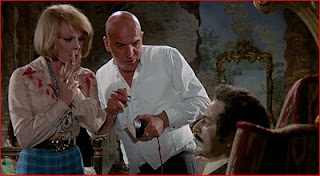

If you decide to check out "Lisa and the Devil"/"The House of Exorcism", make sure you take the time to watch "The House of Exorcism" a second time while listening to the commentary track by Alfred Leone and Elke Sommer. Leone's discussion of how and why the recut version of the film came to be is absolutely fascinating. (Actually, you might just want to skip straight to watching it with the commentary. You won't be missing much, because everything good you've already witnessed in "Lisa and the Devil".)


Thursday, July 8, 2010

'Bell Witch Haunting' is a fine spook fest

The Bell Witch Haunting (2004)
Starring: Ric White, Doug Moore, Stephanie Love, Amber Bland, Hope Wade, and Frank Fox
Director: Ric White
Rating: Six of Ten Stars

When a ghost of mysterious origins and desires invades the home of John Bell (Moore) and his family, Reverend James Johnston (White) and other concerned citizens of a small Tennessee town attempt to discover the reasons for the haunting.

"The Bell Witch Haunting" is based on reports of a real-life haunting that took place over four years early in the 19th century. The haunting reportedly started without warning or apparent cause and continued until family patriarch John was driven into his grave. The spirit's activities were reportedly witnessed by hundreds of people, including President Andrew Jackson, and when they ended as suddenly as they began, a tale full of mystery, horror, and tragedy was born. Director/writer Ric White takes full advantage of everything this tale has to offer in this film.

In the film, writer/director/star White uses James Johnston's conversation with a pair of newspaper reporters working on a story about the Bell Witch Haunting as the "excuse" to tell us the tale of the harrowing events. It also, more by accident than design, drives home the point that White is the best actor in the whole movie. The difference between the way White portrays Johnston in the flashbacks--a self-assured, compassionate man of God who wants to help a good friend and righteous man rid himself of a tormenting spirit--and the Johnston of the present day--who is an embittered man driven to the brink of madness by his confrontation with an incomprehensible evil.

And incomprehensible is what the Bell Witch Ghost is from the very beginning, and its motivations and methods remain shrouded in mystery and riddles from the characters and viewers of the movie alike. As regular readers might be aware, I tend to be very annoyed with horror movies that don't give at least SOME insight into the reasons for why the events depicted happen; I don't necessarily need everything wrapped up in a neat little package, but I want some sort of explanation for or insight into the reasons why the supernatural had invaded the lives of the characters of the story.


However, there are exceptions to everything, and "The Bell Witch Haunting" is one of those exceptions. Although the opening of the film seems to provide a possible explanation of why the Bell family ends up haunted--one of the elder brothers may have shot some sort of familiar or shapeshifted sorcerer--it's far more likely the strange events during the hunt that day were simply the point at which the mysterious spirit became attracted to the family. But we never find out what the trigger was, because the ghost never tells and, try as they may, the characters never discover the truth. The haunting just grows more and more creepy until it ends in tragedy for the family. (The tragedy and horror is emphasized by a strategic placement of a scene of normalcy and happiness--a birthday picnic held for the oldest of the Bell girls-- that is ultimately shattered by the spirit as it lashes out at the family and their friends more viciously and incomprehensibly than ever before.)

Despite the lack of answers, the film ends up being a very satisfying viewing experience, a well-filmed and well-paced tale that is rich in atmosphere and that anyone who appreciates a good ghost story will be entertained by. That entertainment will flow from the very effective and creepy imagery that White fills the picture with. Despite the fact that the ghost is only seen three or four times in the entire film--and each tilme very, very briefly--its presence is felt throughout because of the creative camera angles and highly effetive lighting of scenes that White uses.

That is not to say "The Bell Witch Haunting" is perfect. The majority of the cast gives very stagy performances and most of their efforts say, "Look at me, I'm ACTING!" This feeling could have been lessened in some scenes if the editing had been tighter, but it nothing but more experience in front of cameras could have improved things enough.

The film also suffers in the audio department. It seems evident that the sound was recorded with microphones mounted on the video cameras used to shoot the film, and it is often so muddled that it's difficult to make out what is being said. It's a common problem with low budget films these days, but it's a shame that a movie that is otherwise well shot and well written should come up short in this all-important technical department.

Although flawed, I think "The Bell Witch Haunting" is one of the best ghost movies of recent years. White is a writer, actor, and director of no small degree of talent, and I think that if he had been working with a budget measured in the hundreds of thousands instead of tens, I am certain I would be giving this film a Seven rating at least.


Wednesday, June 9, 2010

'The Shunned House' is a messy place to visit

The Shunned House (2003)
Starring: Giuseppe Lorusso, Federica Quaglieri, Emanuele Cerman, Silvia Ferreri, Michael Segal, Cristiana Vaccaro, and Roberta Marrelli
Director: Ivan Zuccon
Rating: Five of Ten Stars

Alex (Lorusso) and Rita (Quaglieri), while working on Alex's latest book, investigate an abandoned inn with a reputation for being haunted, cursed, and generally just Plain Bad News. While they wander through the decaying structure, Rita starts having disturbing visions as the past and present being to collide, and the evil in the house reawakens....


"The Shunned House" is a kinda-sorta anthology film that loosely adapts three Howard Lovecraft short stories. I say kinda-sorta, because all three stories are intermixed, unfolding in an almost random order, with bits of other hauntings that take place in the inn creeping in around the edges. The tales flow in and out of one another, with sometimes no more than a lighting change or a switch in the musical score to alert the viewer to the fact that we have switched storylines again.

The three stories that take place in three different time frames are intermixed, as Rita has visions and nightmares during her stay in the decaying rooms of the Crossroads Inn. The grisly and mysterious death of a sleepwalking mathematician whose formulas may have opened doors that should have stayed closed during the 1940s (an adaptation of "Dreams in the Witch-House"), and a writer and a young girl who spends her nights playing music to keep demons at bay during the 1920s (an adaption of "The Music of Erich Zann"), are interspersed with the modern day developments of Rita growing increasingly sick from the house's influence while Alex takes notes for his book (an adaptation of "The Shunned House"). There may also be a fourth storyline... I can't quite make sense of where the torturer, his victim, and his vengeful employer that appear at various points in the film, and I can't remember such elements in any of the three stories adapted here (although it has been several years since I've read any of them), but it's the only one that seems to feed directly into the overall developments relating to Alex and Rita.

The way the storylines of the film are presented is both a strength and a weakness. On the one hand, the jumbled, organic nature of their presentation gives a dream-like quality to the movie that feeds the sense of unease and horror it so expertly invokes, but, on the other hand, only one of the stories actually reaches a conclusion, and none of them fully manages to build to the fever ptich of terror that is the hallmark of a Lovecraft plot. ("The Music of Erich Zann" is the one that comes closest, and even it doesn't quite manage to capture the sense of a Lovecraft climax.)

Part of the problem with the adaptations here lies, I think, with a lack of understanding on the part of the screenwriters of what makes a Lovecraft climax work. I think that when stripping out the florid language that makes his stories such interesting reads (but which can, of course, never be brought into a movie) they failed to notice that while his stories always end with copious unanswered questions, they do end. With the exception of the storyline of the violinist playing to ward off demons from the darkness, every plotline here just sort of trails off. Unlike a Lovecraft tale, we don't get a climax in the end, but just unanswered questions.

Another weakness of the film is the actors. While they are far better than what I've seen in many movies of this type, they are still come up short. The worst of the bunch are Giuseppe Lorusso and Federica Quaglieri, not so much because they are individually all that bad, but because there is no on-screen chemistry between them whatsoever... and this is a vitally important aspect to make us care about the characters and to make a third-act revelation by Alex have any real impact on the viewers. (The two other on-screen couples are somewhat better--with Emanuele Cerman and Silvia Ferreri in the "Dreams in the Witch-House" segments being the stongest performers of the bunch.)

For all those complaints, though, this movie was a fine viewing experience, far better than I had expected.

The photography, lighting, and production design on this film are spectacular. It is plainly shot on video, but it has virtually none of the flat quality that many of films recorded on that media do, and there's nothing cheap or substandard about the technical work that is on display here; the film looks better than many horror movies that were made for twenty times the cost of "The Shunned House".

The high-quality photography and lighting is complimented by an equally impressive display of skill on the part of the sound designers and the composer of the musical score. Many scenes include subtle ambient sounds that serve to heighten the creepiness and mystery of the haunted inn. I was also impressed with the musical cues that are used to help the audience keep track of the mystical flashbacks when first start fading in and out. Very few low-budget movies are blessed with music as well-done as what we find here.


Even more, the violin music in the "Music of Erich Zann" storyline is nothing short of amazing. It's the one place where I must eat my words that Lovecraft's "florid prose" can't be presented on the screen--the music that Carlotta Zann plays late at night is supposed to be unlike anything protagonist Marco has ever heard, and we are presented with haunting, unusual music that actually makes us believe it's possible. (The audio distortions--part of the music actually being run backwards?--that get added to the music at points in the story makes it even more believable. For a sample of the violin music in question, visit the official website devoted to the film. Make sure you have the sound turned up on your computer.)

"The Shunned House" is a film that's visually striking and technically competent in every way. It manages to create and maintain a sense of dread throughout its running time, and I wish I could like more than I do. There are so many good things about it, but the weaknesses of the film loom large when it is viewed. They are severe enough that this barely rises to the level of an average movie, and I really wish I could have given it a better score in the end.

Still, this is a film that the creators of big-screen crapfests like "Boogeyman" and "The Skeleton Key" would have been well-advised to have seen and emulated when they did their films, as Ivan Zuccon did far more with far less than they did. It should also be considered a must-see by anyone out there who is considering making their own low-budget horror film. This is (in everything except the story) an example of how it should be done.


Wednesday, April 21, 2010

Welcome to the dead-and-breakfast

House (2008)
Starring: Reynaldo Rosales, Heidi Dippold, J.P. Davis, Julie Ann Emery, Michael Madsen, Allana Bale. Leslie Easterbrook, Lew Temple and Bill Moseley
Director: Robby Henson
Rating: Five of Ten Stars

Two couples (Dippold & Rosales and Davis & Emery) are trapped in an isolated country mansion-turned-hotel with murderous proprietors on the inside and a serial killer on the outside. It soon becomes apparent that there's more to the house than meets the eye, as the four victims are not just stalked by killers but also haunted by visions of deeply held, dark secrets. And is the mysterious girl who offers help and cryptic advice (Bale) a fellow prisoner or just another player in a sick and deadly game?

There is a lot to like about "House", particularly if you enjoy haunted house movies that are free of gore and sex. (I'm not entirely sure why its even rated R, as I've seen more foul language, sexuality, gory violence, and intense scenes in some PG-13 horror films.)

Sadly, it a far from perfect and in the end the flaws weigh more heavily on the film than that its good parts. It's better than most contemporary horror films because it breaks with them in a number of areas, but it's still not going to be counted among the classics.


Saturday, April 10, 2010

'Beyond Evil' is worth going for

Beyond Evil (1980)
Starring: John Saxon, Lynda Day George, Michael Dante, and Janice Lynde
Director: Herb Freed
Rating: Six of Ten Stars

When loving couple Larry and Barbara (Saxon and George) move into a house acquired for them by Larry's scheming friend Del (Dante), the man-hating spirit of a voodoo queen who was murdered there (Lynde) is awakened. The spirit first attempts to kill all the men in Barbara's life, and then it possesses Barbara and tries to kill even Larry. Will a force beyond death--and beyond evil--consume the inhabitants of the small South Sea island, or will Larry find a way to defeat the ghost?


This is a fabulous low-budget chiller that features a great collection of energetic and ethusiastic actors--there are literally no bad performances anywhere--and showcases steady, focused direction of the kind that movies with ten times the budget are often lacking.

On the downside, the film features some rather laughable visible effects. In most cases, the filmmakers seemed to be aware that their budget limited what they could do--and they got by quite effectively with creative lighting, fog machines, jump-cuts, and other inexpensive movie gimmicks--but then they also decided to do some animation effects. These were passable when all they were used for were to illustrate whenever the ghost was up to something evil, but when they started showing laser beams shooting from the eyes of the possessed Barbara, the animation went from cheap-looking to rediculous.


Despite the occassional special effects missteps, "Beyond Evil" is mostly a competently executed haunted house/possession flick. It sags a bit in the middle--where the voodoo queen flexes her supernatural muscle and things get a bit repetative as Larry tries to convince the increasingly strange Barbara to seek medical help--but for the most part it remains an engrossing little movie that's worth a look.


Tuesday, March 2, 2010

'Death at Love House' is a flawed TV movie

Death at Love House (aka "The Shrine of Lorna Love") (1975)
Starring: Kate Jackson, Robert Wagner, and Sylvia Sidney
Director: E.W. Swackhamer
Rating: Four of Ten Stars

Donna and Joel Gregory (Jackson and Wagner) are researching a book about highly-revered and long-dead Hollywood film goddess Lorna Love. They decide to stay visit Lorna's estate, which is still being tended by her long-time housekeeper (Sidney). Things take a turn for the worse when Joel, whose father had had a passionate affair with Lorna, becomes obsessed with the deceased movie star and starts to have waking dreams of a life spent with her. Is Donna losing her husband to the ghost of Lorna Love?!


I enjoy watching Kate Jackson--she's my favorite "Charlie's Angel" and she made "Scarecrow and Mrs. King" the fun show it was. Her quirky voice, cute looks, and superior acting ability brighten everything she's in, and it's only her presence in "Death at Love House" that pulls it up to a rating of Four (and only barely).

This is a film that's well-acted by a literally stellar cast (in addition to the stars, it features cameo appearances by a whole slew of old-time actors and actresses, including horror great John Carradine), and that takes full advantage of the location--which was actually the home of real-life silent film star Harold Lloyd--but which is killed by a atrocious script and some really bad production design/direction at key moments. The film is overburdened by too many elements that don't pay off in any meaningful way (whatever happened to Lorna's "spiritual advisor" who keeps cropping up?), shoddy details when it comes to historical looks (at one point Joel watches one of Lorna's old silent movies,but instead of looking like a leading lady from 1923, she looks just walked off a porn movie set in 1973), and an already reliance on characters behaving stupidly in order to make the plot work (someone tries to kill Donna, there are three people in the house, and no one calls the cops or checks up on the housekeeper?!).

"Death at Love House" is a weak melodrama that tries to be a suspense/horror movie, and it fails. It's too bad to see such a good cast wasted on such a weak movie, especially the wonderful Kate Jackson.


Saturday, February 27, 2010

Double Feature Spook Spectacular: 'The Grudge' and 'The Grudge 2'

I'm reviewing the first two American installmentss of Takashi Shimizu's "The Grudge" series in this post. Tomorrow, I'll be posting the review of the Japanese "The Grudge 2," which seems to follow on the events described in these movies. I don't know if that's just me trying to impose order on chaos, as I don't have the impression Shimizu gives a rip about story continiuity. (And I'm not likely to seek out the original Japanese "The Grudge." The awfulness of these three films has been quite enough for me.)


The Grudge (2004)
Starring: Sarah Michelle Gellar, Jason Behr and Medaka Ikeno
Director: Takashi Shimizu
Rating: Three of Ten Stars

In "The Grudge," Americans living and working in Tokyo fall victim to curses and angry ghosts tied to a house in the city. The most recent victim (Gellar) sets out to discover the cause of the deadly and nightmarish events and hopefully to prevent the fate that is occuring to everyone around her to her.


While "The Grudge" features some interesting visuals surrounding the ghosts in the film, the scares are all of the "gotcha" variety, the script is disjointed and badly done, and the activities of the ghosts and the curse never really make any sense.

It's okay to have a crazy ghost with strange motivations. It's even okay to have a ghost with motivations that SEEM to be understandable but which are ultimately revealed not to be. It's okay to have a ghost that may have been a victim in life but which is also completely and utterly batshit crazy and evil. It's even okay to have all of those.

But what is not okay is to have a ghost (and subsequently a ghost story) that seems to have no rhyme or reason to it. Sure, the characters might die horrible deaths without ever knowing what's going on, but the audience should be left with at least an inkling that there is some underlying cause for the haunting and ghosts actions other than a writer/director being too lazy to think his own story through properly.

"The Grudge" is a ghost movie done in by laziness on the part of the creator, and no amount of CGI effects and cheap scares can make up for that laziness. Unfortunately, things only get worse in the sequel. It's a shame that a good cast (including Sarah Michelle Gellar, Sam Raimi and Bill Pullman) are wasted on such a bad movie.


The Grudge 2 (2006)
Starring: Amber Tamblyn, Arielle Kebbel, Matthew Knight, Edison Chen, Sara Roemer, and Teresa Palmer
Director: Takashi Shimizu
Rating: Three of Ten Stars

The "most haunted house in all of Japan" continues to curse victims... and now it's gone global.


"The Grudge 2" is like the original. It's got the same good parts, and the same bad parts, only moreso in both cases. The curse and its motivation still makes absolutely no sense, nor does the reasons for why the angry ghost targets who she does. In fact, ambiguity is even worse in the sequel, because it appears that the ghost isn't just tied to the house, but that it will go anywhere and target anyone... even people who have absolutely nothing to do with the house or anyone who has ever been in it. Further, it appears that the ghost isn't just the original ghost, but that all its victims are somehow being it. Or something. Or maybe another restless, tormented spirit was house-sitting while the O.G. (Original Ghost) is globetrotting.

Without spoiling too much, this sequel features not just one tale of mysterious hauntings but three--one with Amber Tamblyn and Edison Chen trying to unravel the curse a few days after the events of the first movie; one with Arielle Kebbel and Teresa Palmer a few years later when some mean school girls use the house for a bit of hazing; and a Chicago apartment building where, a few weeks after the ill-fated hazing in faraway Tokyo, teenaged Sara Roemer and her little brother Matthew Knight notice their neighbors start behaving strangely. The film moves back and forth between them, and toward the end of the film it does so in a fashion that seems truly random, and really confuses the viewers sense of what is happening when. I've seen at least two reviews claim the three stories don't connect, and I can only assume that the critics either didn't see the last few minutes of the movie, they weren't paying close enough attention, or they weren't expressing clearly enough the fact that the three stories don't connect in any way that makes sense.

And that is the problem with "The Grudge 2". Nothing in any of the stories feels properly grounded in even a shred of internal logic. There's no reason for "the curse" to target some of the people it does--like every resident on a floor of a Chicago apartment building. Stuff just happens because it's time for something spooky. There are plenty of spooky developments and even more "gotcha!" scares (although a couple of those were more laugh-inspiring on a "Evil Dead" level than actually scary... and I don't think they were going for comedy).

Oh... and here's an illustration of why your Mom told you to always put on clean underwear in the morning.


You never know when you might get caught in a phone booth with a ghost looking up your skirt.


Sunday, December 13, 2009

Will anyone survive the night in 'Murder Mansion'?

Murder Mansion (aka "Maniac Mansion") (1972)
Starring: Evelyn Stewart, Andres Resino, Analia Gade, Annalisa Nardi and Alberto Dalbes
Director: Francisco Lara Polop and Pedro Lazaga
Rating: Six of Ten Stars

A group of strangers, lost in the fog on isolated back roads, are forced to spend the night in a mansion at the edge of a cemetery. Although their hostess (Gade) seems welcoming enough, a night of murder and terror ensues.


"Murder Mansion" is a well-acted, well-filmed, and very moody gothic horror film. While it's got its fair share of characters doing stupid things just to move the plot along, and a few predictable twists, there are enough twists and startling surprises that the short-comings can almost be forgiven. If you like haunted house movies, I think you'll enjoy this film. (That's not to say the mansion our travelers find themselves trapped in is haunted... or is it? (Duhn-duhn-daaaaaah!))

With a surprisingly small amount of gore and nudity for an Italian horror film from the early 1970s, this film instead relies on effective camerawork and a decent script to bring the sort of chills and scares necessary to make a truly effective haunted house movie. It feels like they took the sensibilities of the thrillers and horror films from the late 1950s and early 1960s and updated them for the 1970s. If Hammer Films had done this--instead of going the more gore and boobs route--perhaps they would have lasted.


Friday, December 4, 2009

'Return to House on Haunted Hill' is a wasted trip

Return to House on Haunted Hill (2007)
Starring: Amanda Righetti, Erik Palladino, Tom Riley, Kevin Pacey, Andrew Lee Potts, and Jeffrey Combs.
Director: Victor Garcia
Rating: Four of Ten Stars

Treasure hunters are trapped and targeted for death by angry spirits when they invade Hill House in search of an evil idol reputed to be hidden there.


This sequel to a misguided remake of the original "House on Haunted Hill" is a smidgen better than the movie it follows, but it actually suffers becausethe tenious connections it has to the 1999 movie leads to logical lapses and plotholes. (The biggest of is the way the groups of characters can just wander into the house easily and unchallenged. After the events of the other film, whoever owns it would HAVE to have taken steps to secure it. And don't get me started on the "hey, let's break the locking mechanism of the house by shooting at it" scene.)

The logical lapses, however, are minor whem compared to the bad dialogue that is standard throughout this film and the Stupid Character Syndrome that comes into play more than once to keep the flimsy plot moving--even when allowing for ghostly befuddlement of wits, several characters in this film are so stupid one wonders how they remembered to breathe.

The actors do a pretty good job with the material they have--Eric Pallandino is particularly fun to watch as he chews up scenery as the evil treasure hunter who is the inadvertent cause of everyone else's doom--and the special effects are passable. But, overall, this is a pretty weak film which deserves to fade into total obscurity.